
In Thailand, accounting and tax cannot be separated. Your books are the starting point for your corporate income tax return, and Thai tax law in turn shapes how you record and report transactions. This guide explains how the two connect, where they differ, and how to manage both in one workflow.
What accounting and tax mean
Accounting
Accounting is the process of recording, classifying and summarising a business’s financial information so that owners, lenders and regulators can make decisions. It shows your financial position, performance and cash flow. In Thailand, the Accounting Act B.E. 2543 (2000) requires businesses to keep accounts (Sections 8 and 9) and supporting documents (Section 12), to close the accounts (Section 10), to prepare financial statements (Section 11), and to keep books and documents for at least five years from the closing date (Section 14).
Tax
Tax is money that the government collects from individuals and companies. For a company, the main tax on profit is corporate income tax (CIT), at a standard rate of 20% of net profit (Revenue Code, Section 67). Complying with tax law and planning ahead are core parts of financial management.
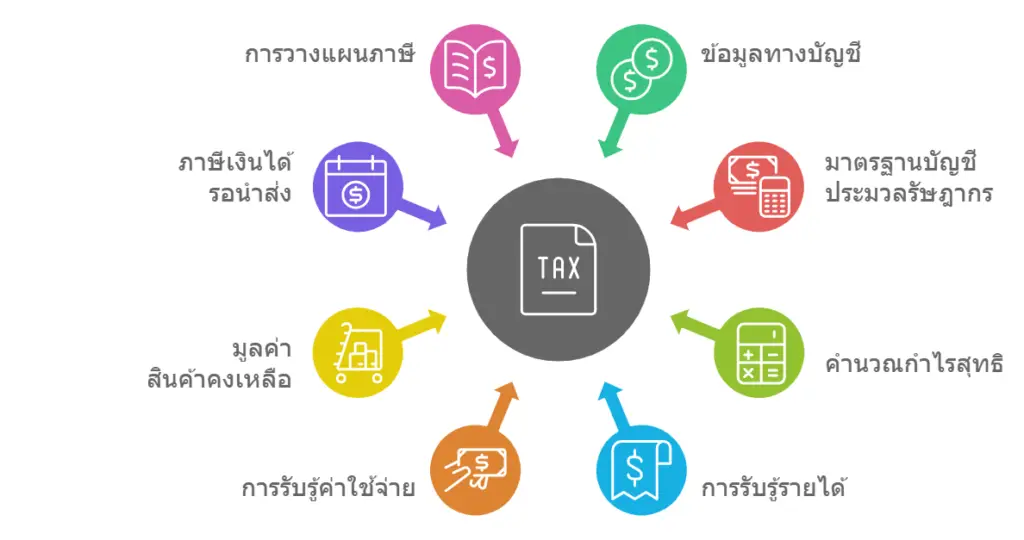
How accounting and tax are linked
Accounting data is the basis for calculating tax, while tax rules decide which items count, and when. The main points of connection are below.
From accounting profit to taxable profit
Thai CIT is calculated on net profit, being revenue less expenses on an accrual basis (Revenue Code, Section 65). The rules for deductible expenses are in Section 65 bis, and the items that cannot be deducted are listed in Section 65 ter. Accounting profit is therefore adjusted to reach taxable profit. Typical adjustments include:
- Non-deductible expenses, such as reserves, expenses with no identifiable payee, fines and surcharges, and entertainment above the limit (Revenue Code, Section 65 ter).
- Depreciation that differs from the statutory rates (Revenue Code, Section 65 bis (2); Royal Decree No. 145 (B.E. 2527)).
- Tax losses from prior years, which may be carried forward for five years (Revenue Code, Section 65 ter (12)).
“The following items shall not be allowed as expenses in the calculation of net profits: […] (18) Expense which a payer cannot identify the recipient.”
Revenue Code, Section 65 ter — Revenue Department unofficial English translation
Entertainment expenses are capped at 0.3% of revenue or paid-up capital (whichever is higher), up to a maximum of 10 million THB (Ministerial Regulation No. 143 (B.E. 2522)).
Recognising income and expenses
Accounting rules for recognising income and expenses can differ from tax rules. For example:
- Instalment sales: the accounts may recognise the full revenue on delivery, while the timing of taxable income can follow different rules, so check the tax position with your accountant.
- Doubtful debts: the accounts may carry an allowance based on estimates, but for tax, a bad debt can be written off only if it meets the rules and conditions set by Ministerial Regulation (Revenue Code, Section 65 bis (9)). Reserves are generally not deductible (Section 65 ter).
Inventory valuation
The method you use to value stock affects cost of sales and gross profit. Section 65 bis sets rules for valuing stock for tax purposes, including the lower of cost or market price. If the method in your accounts differs from what the tax rules accept, you must adjust for it.
Deferred income tax
Because accounting and tax calculations differ, temporary differences arise between the carrying amount of an asset or liability and its tax base. Under accounting standards this creates deferred tax. Most non-listed Thai companies report under TFRS for NPAEs, so check with your accountant how deferred tax applies to you.
Tax planning
Understanding the link helps you plan sensibly, for example by choosing a suitable depreciation method within the permitted rates, timing income and expenses lawfully, and using available tax incentives.
Why integrating accounting and tax matters
Legal compliance
Accurate, complete records help you comply with tax law and reduce the risk of audits and back-tax assessments. Late tax payments carry a surcharge of 1.5% per month (Revenue Code, Section 27).
Financial planning and cash flow
Knowing the tax impact of decisions, such as buying assets, borrowing or paying dividends, helps management plan. Half-year CIT (PND.51) is due within two months after the first six months of the accounting period (Revenue Code, Section 67 bis). If the estimate is more than 25% below the actual figure, a 20% surcharge applies on the shortfall (Section 67 ter). The annual return (PND.50) is due within 150 days after the period ends (Sections 68 and 69). Filing electronically currently earns an extra 8 days, an extension that runs until 31 January 2027 (Ministry of Finance notification).
“a company or juristic partnership shall file a tax return […] within 2 months from the last day of a six-month period from the first day of an accounting period”
Revenue Code, Section 67 bis — Revenue Department unofficial English translation
Business decisions
Considering both accounting and tax effects leads to better decisions on business structure, acquisitions or overseas expansion.
Communicating with stakeholders
Financial information that reflects both accounting and tax views helps investors, banks and regulators understand your position.
Common challenges
- Changing tax law. Rules and rates change often, so businesses must keep up.
- Different accounting and tax treatment. Accounting standards and tax law sometimes take different approaches, and both sets of records must be kept.
- Data management. Integration depends on accurate, current data, which is harder with high transaction volumes.
- People. You need staff who understand both accounting and tax.
- Technology. Software can be costly and needs process changes, which may be a barrier for small businesses.
How to integrate accounting and tax effectively
- Design your chart of accounts for tax. Separate non-deductible expenses and record details of items that are treated differently for tax.
- Use suitable software. Choose accounting software or an ERP that supports tax adjustments and fixed-asset registers.
- Build an integrated team. Cross-train staff, or bring accounting and tax advisers into regular meetings with management.
- Plan tax strategically. Include tax in business planning, not just at year-end.
- Track changes. Monitor changes in tax law and accounting standards and assess their impact.
- Strengthen documentation and internal control. Keep supporting documents and consistent records, as the Accounting Act requires.
- Use external experts. For complex issues, consider a firm that offers bookkeeping and tax planning services.
Case study: a Thai manufacturer
This is a hypothetical example: ABC Co., Ltd., a consumer-goods manufacturer and distributor.
Volume discounts
ABC gives volume discounts to large customers through year-end credit notes. In the accounts it records full sales and a provision for expected discounts. Provisions and reserves are generally not deductible for tax (Revenue Code, Section 65 ter), so ABC must track estimated discounts and issued credit notes closely to adjust taxable profit correctly.
Inventory valuation
If ABC values inventory differently in its accounts than the tax rules allow (Revenue Code, Section 65 bis), it must calculate inventory and cost of sales both ways and adjust taxable profit.
Doubtful debts
ABC sets its allowance from payment history and ageing analysis. For tax, only bad debts meeting the legal conditions can be written off (Revenue Code, Section 65 bis (9)). ABC must list the debtors covered by the allowance and classify them by those conditions.
Depreciation
ABC depreciates buildings and equipment over their estimated useful lives in the accounts. For tax, depreciation follows the statutory rates (Revenue Code, Section 65 bis (2); Royal Decree No. 145 (B.E. 2527)), for example 5% for buildings and 20% for machinery and equipment. ABC should keep a fixed-asset register showing both figures.
Long-term contracts
ABC has made-to-order projects spanning more than one accounting year. It recognises revenue by percentage of completion in the accounts, but tax timing can differ. It should keep project schedules for both bases, so it can adjust taxable profit and calculate deferred tax.
Benefits of integration
- Correct compliance and lower risk of audits and back-tax assessments.
- Effective tax planning on investments, structuring and international transactions.
- Better cash flow management through planned tax payments.
- Better-informed management decisions.
- Clearer communication with investors, lenders and regulators.
- Lower costs and fewer errors, with less duplicated work.
- Faster adaptation to changes in standards and tax law.
Future trends
- Digital technology. AI and data analytics will play a larger role in analysing accounting and tax data.
- Real-time reporting. Reporting is moving towards faster access to current data.
- International integration. More cross-border transactions will need systems that handle several jurisdictions.
- Sustainability reporting. Systems will need to measure and report on it.
- New business models. Sharing-economy and digital-asset businesses will create new practices.
Conclusion
Integrating accounting and tax keeps a business compliant and also strengthens management and planning. Owners and managers should invest in the right systems and people, and keep watching changes in the law. Working with experienced accounting and tax professionals helps you handle the challenges and use the opportunities.
FAQ
Why is accounting profit different from taxable profit in Thailand?
Thai CIT starts from accounting net profit, but tax rules limit some deductions. Items listed in Section 65 ter, such as reserves, fines and entertainment above the limit, are not deductible, and depreciation follows statutory rates (Revenue Code, Sections 65 bis and 65 ter).
What is the corporate income tax rate?
The standard rate is 20% of net profit (Revenue Code, Section 67). Qualifying SMEs (paid-up capital of 5 million THB or less and revenue of 30 million THB or less) pay 0% on the first 300,000 THB, 15% on 300,001 to 3,000,000 THB and 20% above that (Royal Decree No. 530 (B.E. 2554), as amended).
When are corporate tax returns due?
The half-year estimate (PND.51) is due within two months after the first six months (Section 67 bis). The annual return (PND.50) is due within 150 days after the accounting period ends (Sections 68 and 69). Late payment incurs a 1.5% monthly surcharge (Section 27).
How long must I keep accounting records?
The Accounting Act B.E. 2543 (2000) requires books and supporting documents to be kept for at least five years from the closing date (Section 14).
Legal references
- Revenue Code, Section 27: surcharge of 1.5% per month on late tax payment.
- Revenue Code, Section 65: calculation of net profit on an accrual basis.
- Revenue Code, Section 65 bis: deductible expenses, including depreciation, bad debts and stock valuation.
- Revenue Code, Section 65 ter: non-deductible expenses, and loss carry-forward.
- Revenue Code, Sections 67, 67 bis, 67 ter: CIT rate, half-year estimate and under-estimate surcharge.
- Revenue Code, Sections 68 and 69: annual CIT return.
- Royal Decree No. 145 (B.E. 2527): depreciation rates.
- Royal Decree No. 530 (B.E. 2554), as amended: SME corporate tax rates.
- Ministerial Regulation No. 143 (B.E. 2522): entertainment expense limit.
- Accounting Act B.E. 2543 (2000): duty to keep accounts (Sections 8 and 9), closing of accounts (Section 10), financial statements (Section 11), supporting documents (Section 12) and five-year retention (Section 14).
- Revenue Department of Thailand (English): www.rd.go.th
Official sources (Thai government websites, mostly in Thai)
- Ministry of Finance Notification on extending e-filing deadlines by 8 days (No. 7, as amended) – filings due up to 31 January 2027
- Royal Decree No. 530 (B.E. 2554) – SME corporate income tax rates
- Revenue Department CIT guide for SMEs (paid-up capital ≤ 5M, income ≤ 30M THB)
- Ministerial Regulation No. 143 – entertainment expense cap (0.3%, max 10M THB)
- Accounting Act B.E. 2543 (Department of Business Development)
- All documents above are published on the Revenue Department of Thailand website (search by document name or number).
Need help? Talk to an English-speaking accountant — call +66 96 969 8592 or message us on LINE.
This article is general information as of September 2026, not tax advice. Thai-language law prevails.